
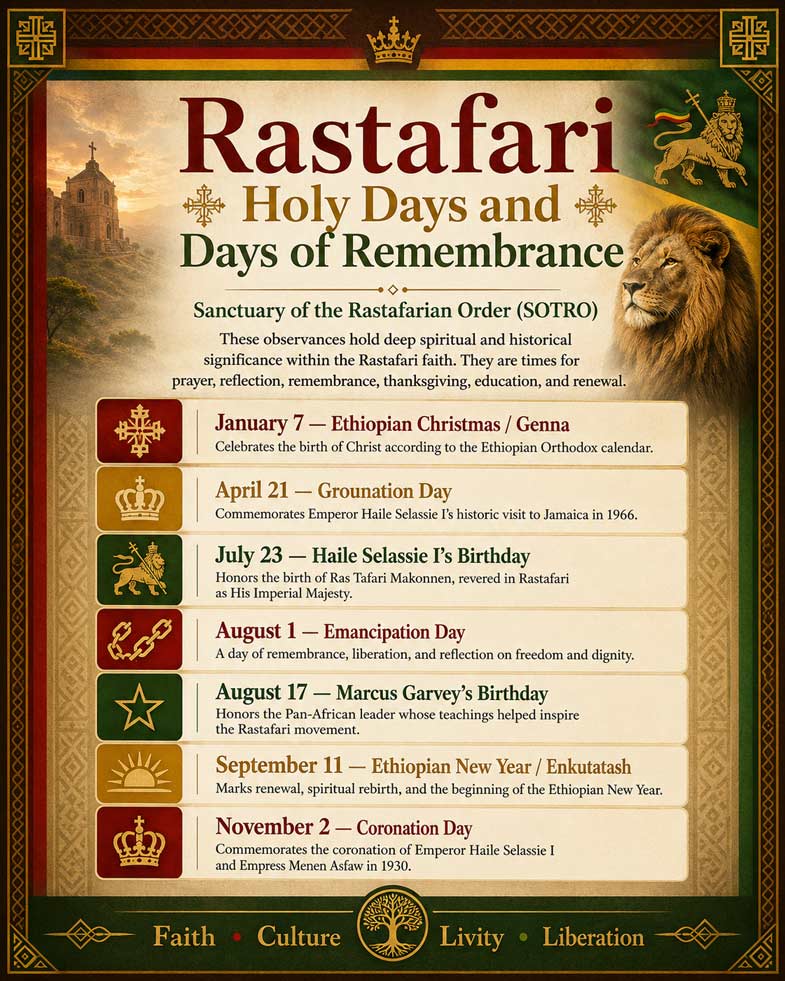

Rastafari Holy Days and Days of Remembrance
The Sanctuary of the Rastafarian Order — SOTRO recognizes several sacred days and historical observances that hold deep meaning within the Rastafari faith, culture, and way of life.
These days are not only commemorative dates. They are times for prayer, reflection, reasoning, thanksgiving, remembrance, education, and spiritual renewal. They help members of the Rastafari community remain connected to African identity, biblical prophecy, liberation history, Ethiopian heritage, and the principles of righteousness, dignity, and self-discipline.
Rastafari observances may vary among different Mansions, Houses, and communities. However, the following days are widely recognized as spiritually and historically significant.
January 7 — Ethiopian Christmas / Genna
Ethiopian Christmas, also known as Genna, is observed according to the Ethiopian Orthodox Christian calendar.
For many Rastafari, Ethiopia holds special spiritual importance because of its biblical history, its ancient Christian tradition, and its connection to Emperor Haile Selassie I. This day is used to reflect on the birth of Christ, the importance of divine order, and the connection between African spirituality and biblical faith.
It is often a time for prayer, scripture reading, peaceful gathering, and reflection on humility, righteousness, and spiritual discipline.
April 21 — Grounation Day
Grounation Day is one of the most important holy days in the Rastafari tradition.
It commemorates the historic visit of His Imperial Majesty Emperor Haile Selassie I of Ethiopia to Jamaica on April 21, 1966. This visit was a defining moment for the Rastafari community, as many Rastafari had long revered Haile Selassie I as a divinely significant figure connected to biblical prophecy, African redemption, and spiritual liberation.
The word Grounation is often understood as a sacred gathering of the community, involving prayer, drumming, chanting, reasoning, and thanksgiving.
This day represents faith, recognition, African unity, and the strengthening of Rastafari identity.
July 23 — Haile Selassie I’s Birthday
July 23 marks the birth of Ras Tafari Makonnen, who became Emperor Haile Selassie I of Ethiopia.
Within Rastafari, Haile Selassie I is honored with titles such as:
King of Kings
Lord of Lords
Conquering Lion of the Tribe of Judah
Elect of God
This day is observed as a sacred time to reflect on his life, leadership, teachings, and symbolic role within Rastafari faith. His example is often connected to principles of justice, education, self-reliance, African sovereignty, discipline, and service to humanity.
For Rastafari, this day is not merely a birthday celebration. It is a day of reverence, remembrance, and spiritual reflection.
August 1 — Emancipation Day
Emancipation Day recognizes the abolition of slavery in the British Empire and is an important day of historical remembrance.
For Rastafari, Emancipation Day is connected to the ongoing spiritual, cultural, and psychological journey from bondage toward liberation. It reminds the community that freedom is not only a legal condition, but also a spiritual and mental responsibility.
This day is used to remember the suffering of African ancestors, honor their resistance, and reflect on the continuing need for dignity, justice, self-determination, and healing.
Within Rastafari thought, emancipation is closely connected to the rejection of oppression, the restoration of African identity, and the pursuit of righteousness.
August 17 — Marcus Garvey’s Birthday
August 17 honors the birth of Marcus Mosiah Garvey, the Jamaican-born Pan-African leader, organizer, and teacher.
Marcus Garvey is deeply respected within Rastafari because his teachings helped inspire African consciousness, self-reliance, repatriation, Black dignity, and global Pan-African unity.
Garvey encouraged people of African descent to look to Africa with pride and to organize themselves socially, economically, and spiritually. His influence helped prepare the foundation for the rise of Rastafari consciousness in Jamaica.
This day is observed as a time to reflect on education, leadership, self-respect, community responsibility, and African redemption.
September 11 — Ethiopian New Year / Enkutatash
Enkutatash marks the Ethiopian New Year and is observed according to the Ethiopian calendar. In some years, depending on calendar calculation, it may fall on September 12.
For Rastafari, Ethiopian New Year is a time of renewal, restoration, and reflection. It represents a new spiritual cycle and a reminder of Ethiopia’s ancient heritage and continuing importance to African people worldwide.
This day may be used for prayer, personal reflection, community reasoning, thanksgiving, and setting righteous intentions for the year ahead.
It symbolizes rebirth, hope, discipline, and forward movement.
November 2 — Coronation Day
Coronation Day commemorates the coronation of Emperor Haile Selassie I and Empress Menen Asfaw on November 2, 1930, in Addis Ababa, Ethiopia.
This day is one of the central observances in Rastafari because the coronation confirmed Haile Selassie I’s imperial titles, including King of Kings, Lord of Lords, and Conquering Lion of the Tribe of Judah.
For Rastafari, the coronation is understood as a spiritually significant event connected to biblical prophecy, African kingship, divine order, and the dignity of Ethiopia.
This day is observed with reverence, prayer, chanting, reasoning, and reflection on righteous leadership, sacred order, and the role of Ethiopia in Rastafari faith.
Purpose of These Observances
The purpose of Rastafari holy days is to strengthen faith, discipline, identity, and community connection.
These observances may include:
Prayer and meditation
Scripture reading
Nyabinghi drumming and chanting where permitted
Reasoning circles
Educational discussion
Reflection on African history
Remembrance of ancestors
Thanksgiving
Peaceful fellowship
Commitment to righteous living
In correctional and institutional settings, these days may be observed through approved spiritual programming, chaplaincy support, written materials, study groups, prayer, cultural education, and respectful accommodation consistent with institutional policy.
SOTRO Statement
The Sanctuary of the Rastafarian Order recognizes these holy days as important expressions of Rastafari faith, heritage, and livity.
They support spiritual growth, cultural understanding, personal accountability, and peaceful religious practice. They also provide an opportunity for education and respectful dialogue between Rastafari practitioners, chaplains, institutions, and the wider community.
Rastafari is a faith tradition rooted in reverence for the Most High, respect for African identity, remembrance of ancestral struggle, and the pursuit of righteousness, peace, discipline, and liberation.
Sanctuary of the Rastafarian Order — SOTRO
Faith • Culture • Livity • Liberation