
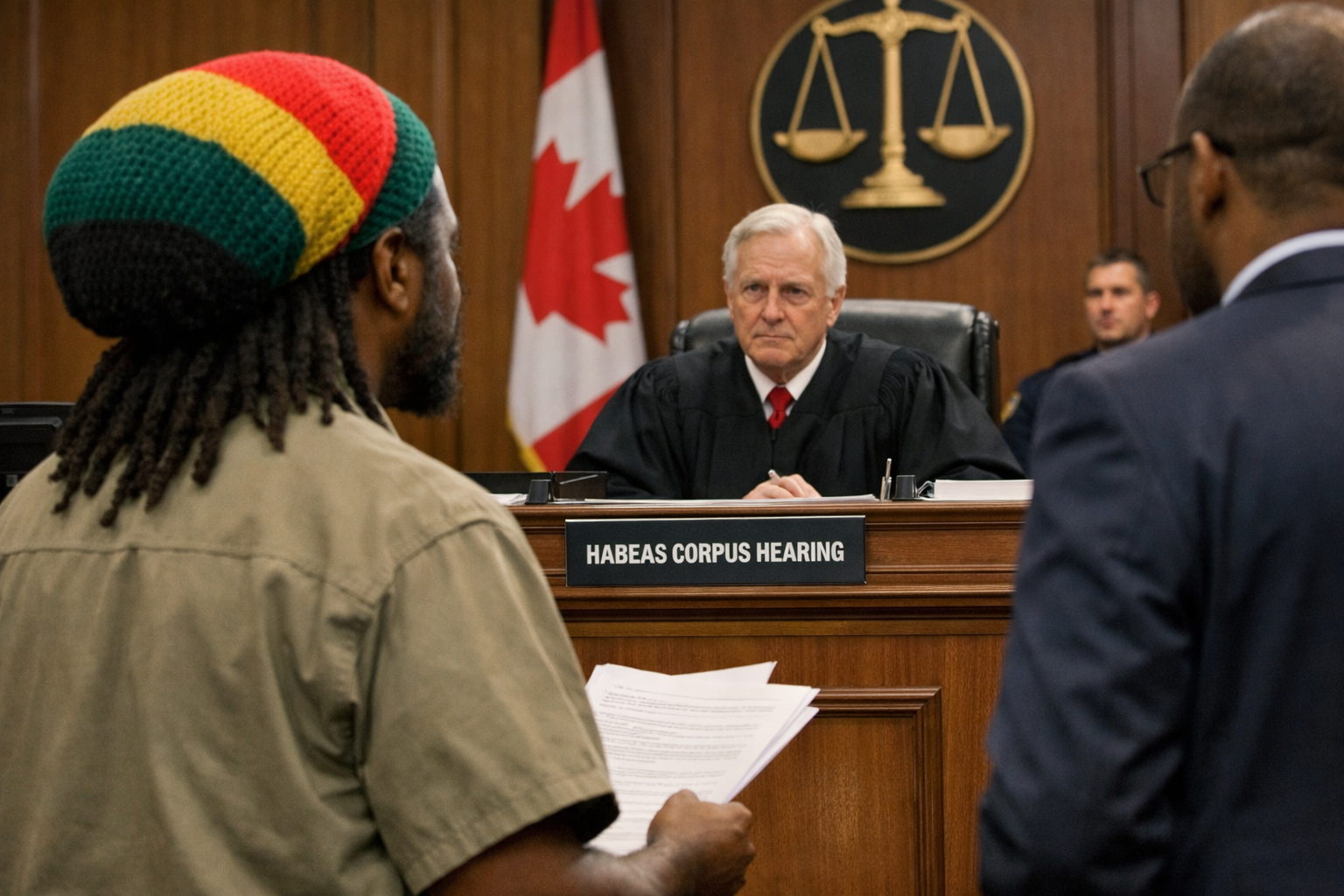

Who Controls the Narrative? Rastafari, Prisoner Rights, and the Post-Dorsey Shift
The Supreme Court of Canada’s decision in Dorsey v. Canada (Nov. 2025) allows federal prisoners to use habeas corpus to challenge denials for transfers to lower-security prisons, a significant expansion of prisoners’ rights by establishing such refusals as a deprivation of liberty. This ruling provides a swifter court review than the previous internal grievance and federal court judicial review, offering a strong avenue for inmates to contest confinement in more restrictive settings, with advocates hoping it helps address systemic discrimination, particularly for racialized inmates disproportionately affected by stricter classifications.
For decades, federal prisoners in Canada—particularly Rastafari inmates—have faced a quiet but powerful obstacle: Correctional Service Canada (CSC) controlled the narrative.
Not just the rules.
Not just the records.
But the meaning of behavior, faith, and identity.
If an inmate refused non-Ital food, the record said “non-compliant.”
If an inmate tested positive for cannabis, the record said “security risk.”
If an inmate pushed back on either, the record said “unmanageable.”
Courts often understood the cultural or religious context—but they rarely intervened. Why? Because until now, security classification and transfer decisions were treated as internal administrative matters, insulated from real judicial scrutiny.
That changed in November 2025.
Dorsey v. Canada: Not a Policy Change, a Power Shift
In Dorsey v. Canada, the Supreme Court of Canada held that denial of a transfer to a lower-security institution can constitute a deprivation of liberty. As a result, federal prisoners may now use habeas corpus—a fast, direct constitutional remedy—to challenge those decisions.
This ruling did not say CSC is wrong about security.
It said something more important:
When liberty is at stake, CSC does not get the last word.
That single recognition fundamentally changes the terrain.
Why Rastafari Inmates Were Uniquely Harmed by the Old System
Rastafari inmates have long been caught at the intersection of faith, institutional rigidity, and subjective risk assessment.
Two issues have consistently been used to justify higher security classifications and denied downgrades:
- Ital dietary observance, framed as refusal or disruption
- Positive drug tests for cannabis, treated as ongoing risk rather than isolated misconduct
Under the old framework, CSC’s internal characterization of these issues rarely faced meaningful challenge. Courts deferred. Grievance systems stalled. Judicial review was slow and deferential.
The result was predictable:
- Religious adherence was reframed as defiance
- Cultural practices were treated as behavioral risk
- Identity quietly became a proxy for security classification
Not because courts rejected Rastafari faith—but because they were never invited to assess proportionality.
What Dorsey Actually Changes
Dorsey does not legalize cannabis in prison.
It does not mandate Ital diets.
It does not strip CSC of authority.
What it does is far more structural.
By recognizing security classification as a liberty issue, the Court shifted who controls the narrative:
Before
- CSC defined the facts
- CSC framed the risk
- Courts reviewed the process, not the substance
After
- Courts examine whether continued restriction of liberty is justified today
- CSC must explain—not assert—why higher security remains necessary
- Proportionality, currency of evidence, and fairness now matter
This is the difference between discipline and punishment.
Reframing the Two Core Issues
1. Ital Diet Is Not a Security Threat
Refusing non-Ital food, when done calmly and consistently, is religious adherence, not unruliness.
Post-Dorsey, the question is no longer:
“Did the inmate refuse a meal?”
It is:
“Does this conduct justify continued deprivation of liberty?”
Absent violence, coercion, or institutional disruption, the answer is increasingly no.
Religious non-conformity does not equal security risk.
2. Cannabis Use Does Not Automatically Justify Higher Security
Cannabis remains contraband inside federal institutions. Courts accept that.
What they no longer accept—automatically—is the leap from isolated misconduct to ongoing liberty restriction.
A single or infrequent positive test, unconnected to:
- Violence
- Trafficking
- Gang activity
- Institutional disorder
cannot, on its own, justify prolonged placement in higher security.
The legal focus has shifted from rule breach to proportional response.
The Real Change: Narrative Authority
CSC will still write the first draft of the record.
But after Dorsey, courts decide whether that draft survives scrutiny.
That is the real transformation.
Rastafari inmates no longer need to win theological arguments.
They need to force the correct legal question:
“Why does this justify restricting liberty now?”
When that question is asked honestly, identity-based assumptions lose their power.
Conclusion: From Internal Control to Constitutional Accountability
For years, CSC controlled the narrative because no one else had jurisdiction.
Dorsey changes that.
This is not about special treatment.
It is about constitutional balance.
When faith, culture, or isolated misconduct are used to justify long-term liberty deprivation, courts now have both the authority and the obligation to intervene.
The system has not fully caught up yet.
CSC culture will resist.
Test cases will matter.
But the ground has shifted.
The story is no longer written behind institutional walls.